Be yourself; Everyone else is already taken.
— Oscar Wilde.
This is the first post on my new blog. I’m just getting this new blog going, so stay tuned for more. Subscribe below to get notified when I post new updates.
Be yourself; Everyone else is already taken.
— Oscar Wilde.
This is the first post on my new blog. I’m just getting this new blog going, so stay tuned for more. Subscribe below to get notified when I post new updates.
Welcome back, everyone! Make sure to check out my last blog post to keep yourself updated on my spectacular posts on mental health. Today I am going to list three applications that I found that will help your mental state in some way, and I feel these are so beneficial and could be just as helpful as other remedies. Let us get started.

Price: Free
Developer: Jackson Tempra
Available for: iOS and Android
Current Rating: 4.6/5 (170 Ratings)
Description: This application is great for general mental health struggles, such as Obsessive Compulsive Disorder, Anxiety, Depression, and more. It contains amazing methods that help you cope with multiple types of disorders, and these methods come from Cognitive Behavioral Therapy (CBT) and Acceptance Commitment Therapy (ACT). Some amazing features are breathing techniques, forums to talk to other people, positive quotes and metaphors, and games to help see how you are doing and how to relax your thoughts. Why this app is so great is because it does not fit into one category and can help many people with various disorders. These techniques, games, and advice all will help people learn to cope and relieve some of their mental health struggles. The interactive features are also great for people to get in touch with themselves without needing to pay a lot of money to go to therapy. Plus, it is free!

The app is easy to use and there are easy directions for the games, such as the one shown above. The visual style is hot pink and blue, which helps keep the user’s attention on the screen, but is not distracting. The cartoons are also a cute touch that keeps the reader interested.

Price: $4.99
Developer: ThrivePort, LLC
Available for: iOS
Current Rating: 4.4 out of 5 (145 Ratings)
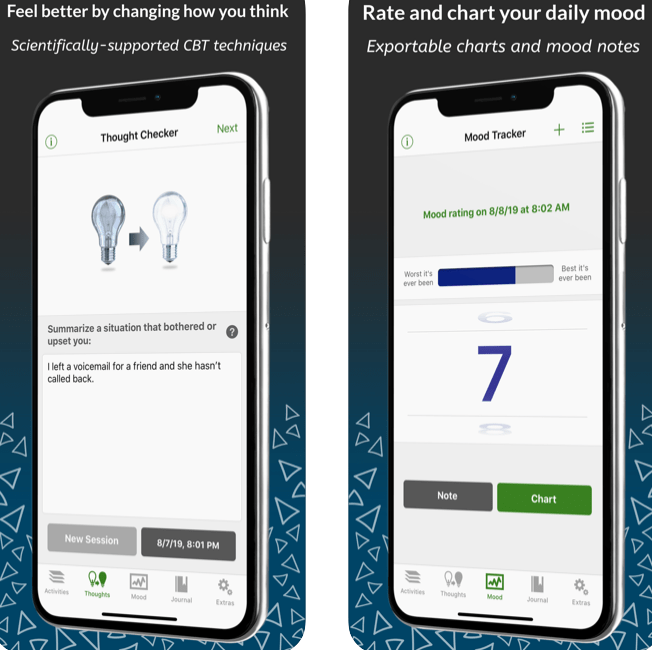
Description: This application is a great app that contains many activities for people who are struggling with mental illness. The activities are used to help improve one’s mood while someone is feeling upset, angry, stressed, and more. You can rate and chart how you feel, develop healthy attitudes, and even journal your thoughts. These activities have been shown to help users develop better long term mental health.
The app is easy to use, and has so many functions in it as well. It tracks your feelings that day and the time it is recorded. You can also set this app to send you reminders to journal or to do a specific thing to help your brain, and so you do not forget. On the app store, it is even rated #93 in Health in Fitness.

Price: $65 to $99/week
Developer: Groop Internet Platform inc.
Available for: iOS and Android
Current Rating: 4.2 out of 5 (9.7K Ratings)
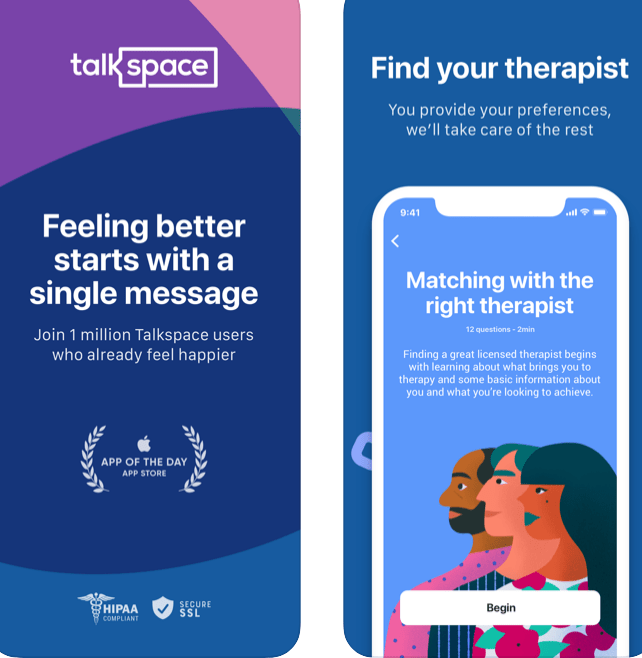
Description: For people who are worried about spending too much money on therapy, TalkSpace is a more affordable way to get therapy. For under $100 per week, you can communicate with licensed therapists, that you are matched with, about your feelings and struggles occurring in your life. If you do not feel comfortable talking about something in person, Talkspace allows you to communicate via text, audio, and video, which is an incredible feature for many people.
A study showed that 81% of people felt this app was more helpful than regular therapy and it already has over a million people using it. This app also lets you track your progress so you can see how you have been doing while working with your therapist. Also, this app is not hard to use, and makes it easy to communicate with the therapists.
These three apps can be potential lifesavers and life changers. Help yourself and your mental health with these apps. They are easy to use, and they make it even fun to talk about your mental health. Download these, and make your brain happy.
Do not forget to check out my twitter @mentalhealthru1 and have an amazing mental health day.
Welcome back to my blog! If you have not been to my blog yet, welcome! You should check out my other blogs MENTAL HEALTH: IS IT A FRAUD?, MENTAL HEALTH: WHY THE STIGMA?, and DOES THE INTERNET KNOW I AM MENTALLY ILL?. My blogs are about mental health awareness. I like to bring up scientific facts, personal opinions, and my social media accounts into my blogs about mental illness. In this blog, I am going to be debunking 8 myths about mental illness that surround social media and conversations. Let’s get started.
MYTH #1:Mental health problems are uncommon
FALSE: That is a statment that is very easy to believe if you have never met anyone with mental health problems or if you do not have any mental health issues, but this statement is actually very false. Surprisingly, according to MentalHealth.gov, one in five American adults experienced a mental health issue.
MYTH #2: People with mental health issues are violent, dangerous, and unsafe to the community
FALSE: This statement is sad as many people do believe that people with illnesses are dangerous, but that is not true. That is very discriminatory. In fact, according to the US National Library of Medicine
National Institutes of Health, most people who have mental health issues do not commit any crimes whatsoever.
MYTH #3: People with mental health issues will never recover
FALSE:This statement is not true at all, as even though mental health issues are hard to deal with, there are so many ways to help lessen the issues and may even permanently help. According to the Mental Health of America Association, medicine, therapy, group therapy, and mindfulness are just a few ways to help people with mental illness recover.
MYTH #4: Mental illnesses are not real medical problems
FALSE: I have previously talked about this in my other blog post and debunked this. Mental health illnesses are real medical health problems and there are scientific facts to prove this. According to WebMD, they explained how mental disorders can be derived from abnormal nerve cell circuits (in the brain) that are not functioning properly, so the neurotransmitters are not communicating properly, leading to mental disorders.
MYTH #5: Children don’t experience mental health problems
MYTH #6: I cannot help anyone with a mental illness
FALSE:This is extremely untrue! If you know someone struggling, being a support system is the best thing you can do for them. According to MentalHealth.gov, learning about the mental illness, researching ways to help, and letting the person know you are always there for them are great ways to help someone.
MYTH 7: Mental health illnesses are contagious
FALSE:Mental health illnesses are not contagious as they are people’s own illness within their brain that come from a chemical imbalance, as perviously mentioned. According to the Optimum Performance Institute, mental illnesses are not like the flu or a cold that people can catch from other people.
MYTH 8: People with mental illnesses cannot hold a job
FALSE:According to the Mental Health of America Association, people with mental illness can work just as well as people without a mental illness, and they want to be in a workforce like everyone else. Just because someone has an illness does not mean they are incapable of working a normal, everyday job.
There we go, debunking some of the most common myths about mental health illnesses! This is important to know so stigmas are not started or continued. Also, if you know anyone with a mental illness, these facts mentioned are important to know so you can help them and reassure them.
Remember when you check sources, to check sources that are from the government, from large associations or organizations, or have .gov or .org in their hyperlink. This will ensure accurate and real data. Make sure to check out my Twitter, @mentalhealthru1, and my Vimeo on exercising and mental health. I am in the process of posting facts and information on mental health illnesses, so follow me on my journey. Tune in next week!

Mental Health
Welcome back for another week of discussing the most difficult thing to talk about: mental health! If you have not checked out my other blogs yet, check out MENTAL HEALTH: IS IT A FRAUD? and MENTAL HEALTH: WHY THE STIGMA? for some more information on mental health awareness. In these two blogs, I have discussed how mental health is hard to talk about and how there is such a stigma around having a mental illness. I also talked about how mental disorders develop in your brain. I have also talked about how you need to be careful when researching mental health issues or disorders because there are some untrustworthy websites on the internet that contain extremely false data.
The Internet and Mental Health
Speaking of trustworthy, have you noticed that when you speak about something to a friend, or when you look up something on your phone, there will be an ad for that on your phone within the next minute? It is like your phone is listening to you. I watched a Ted Talk by Jennifer Golbeck who talks about this phenomenon; our phones and technology track our information and they study consistent things we look up, and this helps certain companies with advertising and with tracking our patterns.
This creeps me out when it comes to mental health searches! When people, who are extremely vulnerable, are looking up medications and symptoms in private, someone on the other side is tracking this information to be able to advertise it to them later. This can also be super triggering. If someone with panic disorder is looking up symptoms during an attack, and then later ads on panic attacks come up, that can trigger a panic attack for that person.
Privacy
Next time you are searching something that is potentially triggering, or you want that information to be in private, unfortunately it is just better to go to the doctor and talk to someone in person because you have no more privacy online anymore. Me, personally, how I would address this issue is by not searching up specific questions I have and just call the doctor; I am a very private person and I do not want my mental health questions out in the open for people to track.
To protect my accounts, I won’t use any material that is copyrighted or plagiarized. When I do use other sources to reference data, I always link the website to the creators and quote them in my blogs as well.
My New Social Media Accounts
I do have some new social media accounts you should follow regarding new updates on mental health awareness. I have a Vimeo on how exercise helps with mental health, so go check out that account to see how exercising can help your mental state of mind. I am starting up a Twitter, @mentalhealthru1, and it will consist of facts, statistics, and inspirational quotes to help my mental health awareness train continue to take off. Thanks for reading, and tune in next week.

Here we go again, the elephant in the room: are mental health issues just made-up feelings crazy people have, or is it a real, science-backed problem people face? If you have never dealt with mental health problems, then honestly, I do not blame you for being skeptical because it is hard to believe in something that you cannot “see”. Now with everything online, it is hard to trust certain websites from other to determine what is false and what is not, like if mental disorders are scientifically proven. I found three unreliable sources and three reliable on mental illness that I thought were interesting to read and compare.
For my unreliable, I first found one post on Reddit yesterday, and it was a user saying how he does not believe in most mental disorders because they are just excuses for people to make themselves feel better. Some other people on the same page also said how they feel people use mental disorders as a trend-setter, as it is almost a fun bonding experience. I also found a picture on Tumblr saying, “you do not have a chemical imbalance… you have a brain”, insinuating that mental illness is scientifically false. I read another article from a blog called Return of Kings that stated how women fake mental illness so that they can drink more alcohol, do more drugs, and get more attention. These blogs and posts are unreliable as there is no scientific or accurate data to back up these opinions.
I decided to look up reliable websites regarding mental health. From the National Center for Biotechnology Information, they stated that scientists have concluded that mental disorders can be developed from multiple brain changes, such as its change in its structure or its changes in its chemical makeup. One of the more common mental disorders, bipolar disorder, I decided to look up to learn about its scientific background. From Latuda (an FDA-approved medication for bipolar disorder), bipolar disorder is caused by a decrease in the neurotransmitter serotonin and a fluctuating amount of the neurotransmitter dopamine. These fluctuating amounts of both neurotransmitters causes moods and emotions to go up and down, causing bipolar disorder. Lastly, from WebMD, they explained how mental disorders can be derived from abnormal nerve cell circuits (in the brain) that are not functioning properly, so the neurotransmitters are not communicating properly, leading to mental disorders.
Overall, I am not taking away one thing: mental disorders are not simple and they are very complex. But, as I first compared unreliable sources to reliable sources, you can see how people can write about extremely untrue statements, and when you are trying to look up facts about a topic, credible sources are the best to trust, not social media platforms like Instagram or Tumblr. The best way to determine if sources are reliable is if they are government based, if they are from a science institution, or if they are scientific articles. If you compare the unreliable to the reliable, you can see how the unreliable are from random people on the internet writing opinions, while the reliable are written from doctors or scientists. Also, look at the hyperlinks; if it ends in .gov or .org, those are reliable sources from an organization or the government.
It’s 2020, and we still are having trouble talking about one thing: mental health. I tend to describe mental health as the health of your state of mind. People tend to say, “oh, she is crazy” or, “wow, he is such a psychopath” in daily commentary. Why is it so hard? Why do we stereotype it so much? Stigmas are very dehumanizing and disrespectful as they create a bias towards a certain characteristic or trait, such as having a mental disorder. As a society, mental health should be taken just as seriously as physical health. Did you know that one in twenty five people have a serious mental illness? Think about your high school class; one person in that math class was, and most likely still is, dealing with a major mental health issue, such as bipolar disorder or severe depression. People daily are battling mental disorders, poor mental health, and much more, and these people are suffering significantly.
There is a stigma towards people with mental health issues. This problem affects anyone, any age, any race, any gender, and any place in the world. A lot get embarrassed to talk about it because they feel that they are “crazy”, and many do not understand what it feels like, so they try to ignore it as well. Also, many think that mental health is a made-up construct and that it is something people can easily fix on their own, versus it actually being a medical issue. People with mental health problems deal with bullying and lack of understanding from people, which can lead to further challenges they have to face. Mental health needs to be talked about more open-mindedly and respectfully; just because people are battling an issue within themselves, versus a visible physical injury, does not mean that there is not a huge battle needing to be faced and conquered. Mental health problems are just as hard to overcome as a physical health problem.
This is an example post, originally published as part of Blogging University. Enroll in one of our ten programs, and start your blog right.
You’re going to publish a post today. Don’t worry about how your blog looks. Don’t worry if you haven’t given it a name yet, or you’re feeling overwhelmed. Just click the “New Post” button, and tell us why you’re here.
Why do this?
The post can be short or long, a personal intro to your life or a bloggy mission statement, a manifesto for the future or a simple outline of your the types of things you hope to publish.
To help you get started, here are a few questions:
You’re not locked into any of this; one of the wonderful things about blogs is how they constantly evolve as we learn, grow, and interact with one another — but it’s good to know where and why you started, and articulating your goals may just give you a few other post ideas.
Can’t think how to get started? Just write the first thing that pops into your head. Anne Lamott, author of a book on writing we love, says that you need to give yourself permission to write a “crappy first draft”. Anne makes a great point — just start writing, and worry about editing it later.
When you’re ready to publish, give your post three to five tags that describe your blog’s focus — writing, photography, fiction, parenting, food, cars, movies, sports, whatever. These tags will help others who care about your topics find you in the Reader. Make sure one of the tags is “zerotohero,” so other new bloggers can find you, too.
 The Best Health is Mental Health!